
Hive Process Pictures
Hive is being presented at The Noise Project Exhibition this Friday, so here’s some documentation of our speaker wiring process, with a more detailed and explanatory post to come after the show about what we’ve learned about speakers and their functionality, as well as some shots of our sculpture’s construction. Neither of us came into this project with much experience working with speakers, or even particular knowledge of how to make it all work, so it’s all been a fun learning process that we’d like to share.
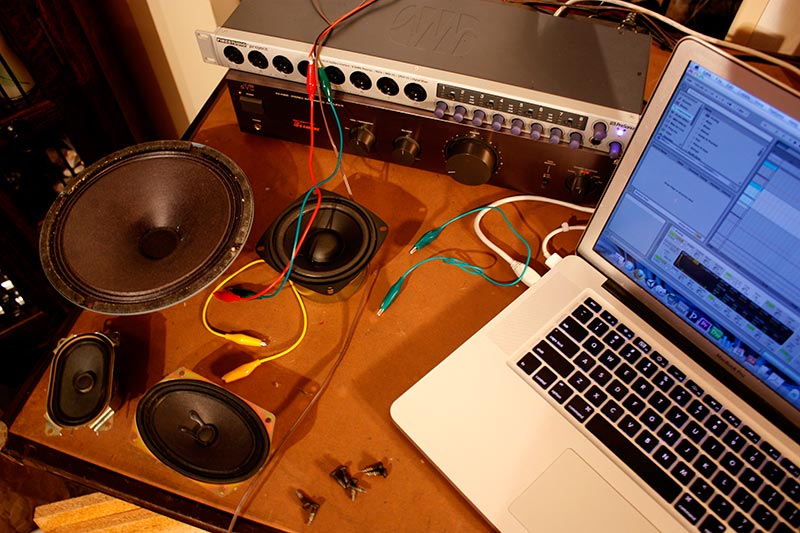
First, we tested a bunch of different speakers both found and purchased to figure out the type of sound/aesthetic we’d like to apply to the hive structure. At this point we were faced with decisions like which frequency ranges are most important for representing our concept and carrying our imagined sound, which comes down to deciding which kinds and how many of each kind of drivers will be used (tweeters vs. mids vs. woofers).
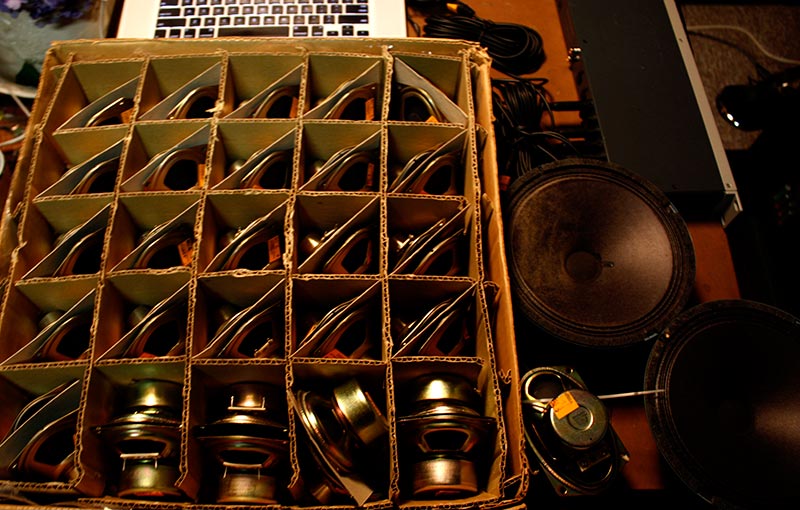
Since our goal is to produce a multi-channel soundscape for participants to explore, rather than a more traditional sound, we decided to stick to uniformity and employ a huge pile of cheap loudspeakers, most often used in car radios. Then we’re adding a couple of woofers to the top and bottom to give it some balls. As seen above, we got ourselves 52 loudspeakers to make up the body of the hive, and were donated a couple of woofers. Overall, Hive is looking to have 50 speakers in total – 48 plus the two woofers.

We’re wiring the loudspeakers as six channels of eight speakers, with each channel consisting of two sets of four 8 Ohm speakers. Each of those two sets will be wired in series to raise the impedance to 32 Ohms, then the two sets of four wired in parallel to bring the impedance down to 16 Ohms. The two woofers will be wired separately on a seventh audio channel. Above is a picture of one of our series-parallel speaker tests with eight loudspeakers.

Sculpturally, the speaker drivers are being wired together through a chicken mesh structure stitched overtop of a bike rim skeleton. The structure will be approximately two feet in diameter and about four feet tall. But we’ll share that part of the process after the show!
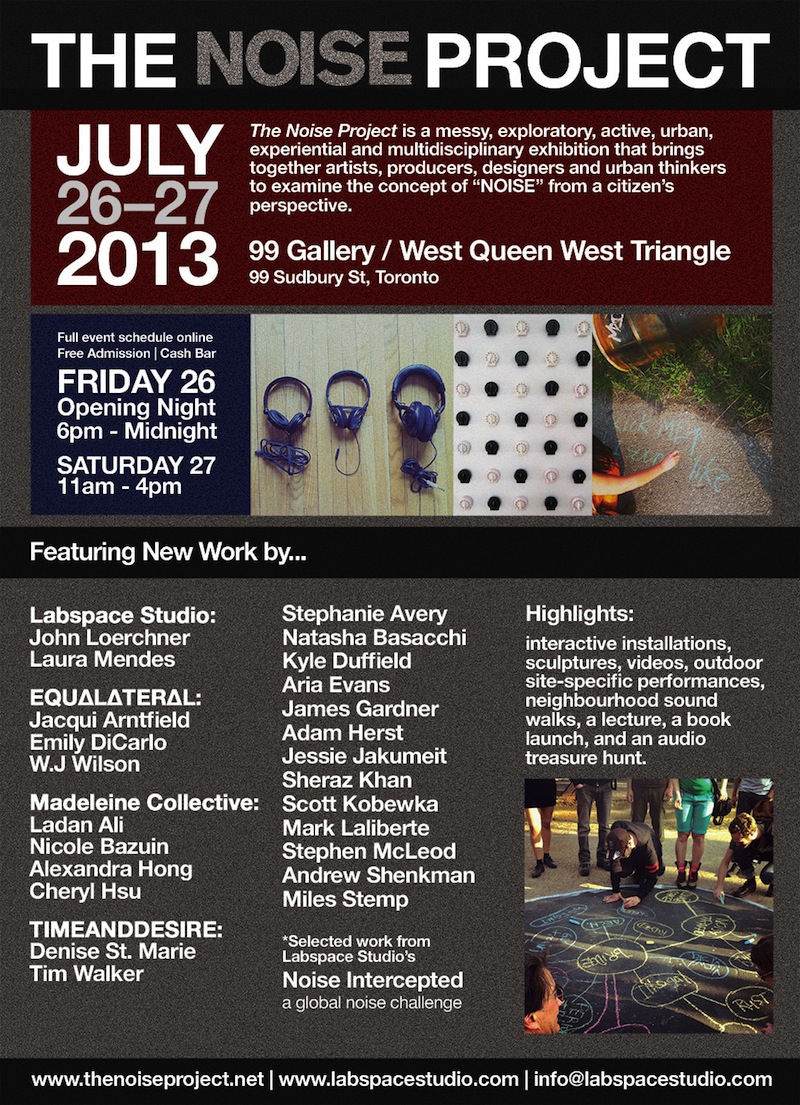
THE NOISE PROJECT EXHIBITION
Opening Reception: Friday July 26th, 4:00 p.m. to 12:00 a.m.
Viewing: Saturday July 27th, 11:00 a.m. to 4:00 a.m.
99 Sudbury
99 Sudbury Street, Toronto
Hive Exhibition Details!
THE NOISE PROJECT EXHIBITION
Opening Reception: Friday July 26th, 4:00 p.m. to 12:00 a.m.
Viewing: Saturday July 27th, 11:00 a.m. to 4:00 a.m.
99 Sudbury
99 Sudbury Street, Toronto
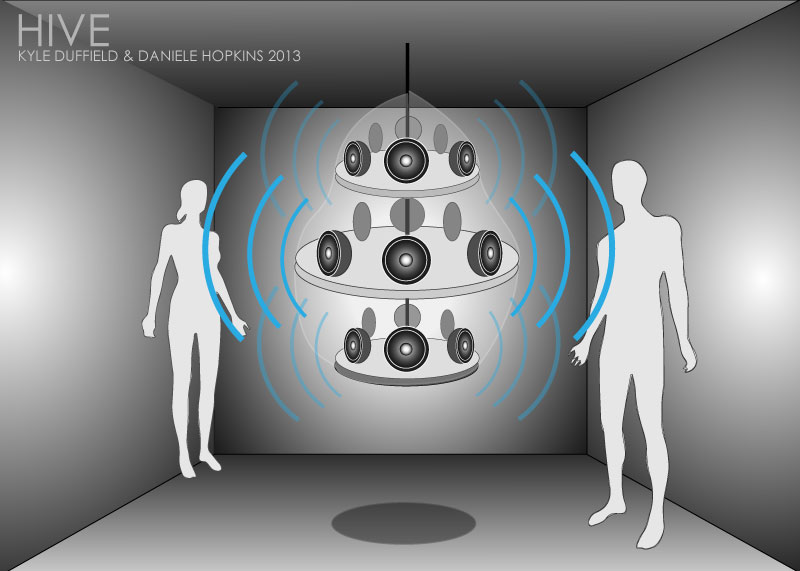
For this exhibition, Kyle Duffield and Daniele Hopkins are combining forces to create Hive, a multichannel sculptural hive of speakers using found and fabricated parts, which will have a pulsating, droning, but changing sound composition, creating the experience of an organism/instrument/speaker hybrid.
In relation to this project, Kyle Duffield is part of The Nomadic Noise Residency, which consists of a super cool multidisciplinary crew of people that are combining together to create artistic projects inspired by noise. Exhibited work will be in the form of site specific installations, performances, sound based works, web-projects, apps, interventions, research papers, etc. The residency itself consists of group experiences such as urban sound adventures, social interventions, workshops and discussions for the purpose of creating final projects for exhibition. The residency is one of three parts of a larger endeavor entitled The Noise Project.
Introducing Hive
Exploring convergences between technology and nature, Hive employs regurgitative paper wasp architectures with technological parts and scraps to create an empty sculptural entity that replaces insects with sound in relation to a participant’s proximity.
In association with Kyle’s participation in Nomadic Noise Residency (which consists of various artists creating sound-inspired work for an awesome show in late July), the two of us are collaborating on a sound sculpture. Currently called Hive, this project is essentially an interactive multichannel speaker sculpture. Things are subject to change as we develop the project, but this is how it’s all looking:
Stay tuned for process and development posts!


Drone
Hopkins and Duffield’s Drone uses documentary source footage about unmanned aerial vehicles alongside footage of insects capable of swarm intelligence to outline the looming parallels between the quiet, yet efficient and often uncomfortable presence of each. Using these two primary video sources, Drone is created through a subtle additive layering of video-music styled editing where the sound matches the visuals cut for cut, what you see is what you hear.
Presented at Videodrome 2013 at the MOCCA, Toronto, Canada.
Thoughts on Audio-Video Editing Software + Videodrome Timeline
Here’s our Premiere Pro CS6 A/V timeline from our video-music piece for Videodrome 2013, minus a handful of nested tracks. This is our first project since we made the switch from Final Cut 7 to Premiere, which was simultaneously a pleasing and infuriating experience.
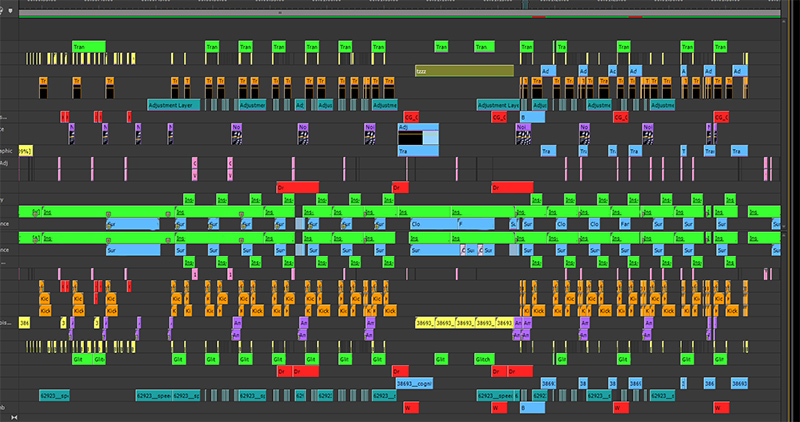
We made the switch because we preferred the option of working on both Mac and PC, and FCPX is pretty good (once you get use to it) — but has a bit of a ways to go and doesn’t seem like it would be the most suited for the video-music style of editing. That being said, Premiere is also is pretty good, but also has a ways to go. The more efficient rendering over FCP7 resulted in less caffeine breaks, and Premiere’s adjustment layer tracks are an awesome feature because they allow you to manipulate multiple tracks at once. However, importing projects from one computer to another, especially given that they’re different operating systems, is not graceful in Premiere (duplicating all references to files in the project browser?!?! Really?!?! And no automatic file reference finder?!? ASDF?!?!).
This is also the first project where we exported the audio cuts from a video editor into Ableton Live 9 for some additional processing/mixing/cleanup. Ableton Live is a dream to use.
It’s a strange time because between FCPX and Premiere (which is grabbing the old Final Cut market), it feels that both programs aren’t quite right for the video-music style of editing (not that FCP 7 was exactly perfect to begin with). The one complaint with Premiere is that there are certain aspects to the workflow that feel a bit roundabout and are lacking straightforward shortcuts for simple tasks that are executed often. If only there was a video editing program with the creative ease of Ableton Live (perhaps there is one that we’re oblivious to?). Working with Ableton Live feels so malleable, direct, and fun.
However, from some experience using VJ software (not that there’s a whole lot of experience, so once again maybe we overlooked something), we have yet to encounter something that’s a solid video editing/performance hybrid that has the immediate tactility that Ableton Live provides. For example, Ableton Live can do classical track based editing/producing, which has been a fairly standard approach for many audio programs as well as non-linear editing software, but it can also easily switch to one of the better sequencing/performance modes. One of the good things about this with regards to workflow is that any of the preliminary edits and organizational tasks are very easy to integrate with extended processing/manipulation of the media – you don’t have to pre-edit in one software, splice everything up, then bring it into an entirely different program to sequence it in a musical way (i.e., mapping it to MIDI, or arranging it on a timeline that works in beats/bars rather than frames-per second), and can be pre-composed to avoid the computer performance issues that happen with extensive real-time processing.
Obviously there’s likely not a huge market for this type of tool….(or is there?)
Our piece, Drone, will be shown at Videodrome on June 7 at the Museum of Contemporary Canadian Art
VIDEODROME 2013
It’s that time of the year again! We’ve been slicing clips, burning our retinas, and over-driving our eardrums for the video battle!
Come out and enjoy a night of noisy and danceable video mashups!
Videodrome 2013 Facebook Event Page!
Museum of Contemporary Canadian Art presents:
VIDEODROME
Audio/Visual Overdose & Video Battle
Friday, June 7, 2013 – 8:00pm until 1:00am
952 Queen St W, Toronto, Ontario M6J 1G8
–Video Battle—
bossFYTE
PETE OHEARN
ISTVAN KANTOR
DAEVE FELLOWS
CRAZY GNOME
CONTORT
BAD CREDIT
TALIXZEN
VIDEO SAMURAI
DAVID MATTON
DR. NEPTUNE
SMEARBALLS
HOPKINS DUFFIELD
–Live A/V—
ϟ†Nϟ & SΛRIN
OUANANICHE
SKEETER
NWODTELM
AUGART
JUBAL BROWN
–Installations—
MANDELBRUT
ROXANNE LUCHAK
KYLE DUFFIELD
Confirmed for Videodrome 2013!
Hopkins Duffield is going to have a video-music piece again this year at Videodrome 2013 – Audio/Visual Overdose & Video Battle at the Museum of Contemporary Canadian Art in Toronto on Friday, June 7th, 2013 at 8:00pm. Check out the Facebook event page!.
Stay tuned for more details!
Adafruit’s Wearable Wednesdays + 4Player Network Write-up + Strap-on Joystick Fighting!
Our working game controller garments have been blogged on Adafruit’s Wearable Wednesday!
Also, we were mentioned in a Vector write-up on 4Player Network:
“I also had the opportunity to see game engines used for feminist performances, the first being Itagaki Interface. Artists Daniele Hopkins and Kyle Duffield use their own bodies to challenge the exaggerated body designs (particularly the infamous jiggle physics) in the fighting game Dead or Alive. It was fascinating and hilarious to me to see the hesitation of many people in the crowd who had a lot of experience with DoA come up and mash combo sequences on the human body controllers, specifically on Daniele’s breasts. I noticed some male participants introduce themselves to her first or apologize in advance for interacting with the controllers which sparked a personal revelation for me – we constantly use and abuse hypersexualized female bodies in games, but if they were personified in front of us the experience would be uncomfortable because the degradation is now real.”
Lastly, since we’ve been seriously considering making a jockstrap version of these controller garments for the last half a year, we thought this project, Using Strap-On Joysticks to Fight With Fake Dicks, was hilarious.
Bracumentation of Our Working Playstation Controller Bra & Bro Performance at Vector!
Event writeup:
The Itagaki Interface was performed at Vector: Game+Art Convergence in Toronto, Canada. The Itagaki Interface was featured in the event, “Playing Personae: Embodied and Engendered Performances” along with Angela Washko‘s performance entitled, Chastity and The Council on Gender Sensitivity and Behavioral Awareness in World of Warcraft at Interaccess Electronic Media Arts Centre on February 22, 2013.
In their performance, Itagaki Interface, Daniele Hopkins and Kyle Duffield use their own bodies to challenge exaggerated representations of the human body in the fighting game, Dead or Alive (PS1), by Tomonobu Itakagi. The game features hyper feminized and hyper masculinized bodies in one on one combat, and more notably, a separate physics engine dedicated towards the characters’ breasts.
The audience is confronted with the challenge of having to compete with one another in the game by manipulating the controllers worn on the chests of the artists. This piece is a hybridization of 70’s body-centric performance art and new media interactive performance, challenging audiences to consider ways in which our bodies are both represented and interacted with in videogames, and highlighting individual choices and motives behind avatar selection.


Thank you to Terry Anastasiadas, Heidi Persaud, and Team Vector for shooting the documentation. Also, thanks again to all who came out to the event, Team Vector (Skot Deeming, Clint Enns, Katie Micak, Christine Kim) and the Vector volunteers, Interaccess Electronic Media Arts Centre, Feminists in Games, The Ontario Arts Council, OCADU’s Digital Futures Initiative and Lisason of Independent Filmmakers for making everything awesome!
Windsor Square Vector Write Up
Our performance, Itagaki Interface, was also mentioned in the Windsor Squares write up of Vector!
“Hopkins and Duffield wore modified chest pieces that were actually controllers to interact with two fighting characters in Tomonobu Itakagi’s Dead or Alive – a game hugely popular for creating “jiggle physics” in the overly busty female fighters. It was fascinating to see men who are well-versed in DoA hesitate to touch the controller on Hopkins’ chest, and the performance was a clever way to challenge players to see how bodies are represented in the media.”
– Soha E
The article also mentions the other events, pieces, and performances at Vector in detail.
Check out the full Windsor Square article here.
 Daniele Hopkins and Kyle Duffield